Fannie Lou Hamer.
Eleanor Nugent Somerville.
Medgar Evers.
Vernon Dahmer.
Andrew Goodman, James Chaney and Michael Schwerner.
Bob Moses.
These are but a few of the persons in not-so-distant Mississippi history who have been committed to the struggle for voting rights for all of Mississippi’s citizens. Voting had long been a franchise for white men; women and black persons had met tremendous obstacles in exercising the right to vote.
And the struggle for voting rights was not a peaceful one: Medgar Evers and Vernon Dahmer were among the black Mississippians who lost their lives in the struggle of helping black persons register and exercise their right to vote.
In 1875, violence erupted in Clinton, Mississippi during what had apparently been planned as a peaceful rally introducing candidates for elected office. Many in attendance were Black Republicans; white Democrats were also in attendance. Black persons had just been given the right to vote through the15th Amendment to the Constitution (one of the three Reconstruction Amendments intended to emancipate formerly enslaved black persons, establish their citizenship, equal protection and due process under the law, and create their right to vote); their ability to exercise that right had allowed Mississippi to see the election of its first black public officials. Hiram Revels became the first black man to be elected by the Mississippi legislature (in 1870) to serve in the U.S. Senate.
But the violence that erupted in Clinton on September 4, 1875 became the stepping stone for the end of Reconstruction in Mississippi. And for the next nearly 100 years, the struggle for voting rights for all Mississippi citizens continued.
Mississippi’s Suffrage Movement became a more organized effort in the early 1900s, when women began organizing meetings and conferences, and working to get legislation enacted that would allow women to be elected to public office. The 19th Amendment to the Constitution, giving women the right to vote, was not ratified in Mississippi in 1920 when it became law. However, women were given the right to vote shortly thereafter, and the first woman to be elected to the State House of Representatives, Greenville’s Eleanor (“Nellie”) Nugent Somerville, was an ardent voice for the right of Mississippi women to vote. [The 19th Amendment to the Constitution was not ratified in Mississippi until 1984 – more than 60 years after the Amendment had been ratified by the requisite 36 states and women’s right to vote had been federally guaranteed.]
But even as white women were achieving the right to vote in Mississippi in the early 1920s, black persons still found it impossible to vote – a disenfranchisement that largely persisted until the 1960s. The Equal Justice Initiative summarizes Mississippi’s voting rights struggle this way:
In the early 1960s, approximately 70% of white adults in Mississippi were registered to vote, but only 6.7% of eligible Black Mississippians were registered. These rates lagged behind even other states in the Deep South, such as Alabama (23%) and Louisiana (32%)…During Reconstruction, Black Mississippians participated in state politics in large numbers and comprised a majority of the state’s electorate by 1870.
What followed, from 1875 through the 1960s, was violence and targeted legislation that served to deprive black citizens of their voting rights. Medgar Evers and Vernon Dahmer were two of the black citizens who had committed themselves to helping other black citizens register and actually exercise their right to vote who were killed for their actions. Following a wave of destruction of black churches where black citizens were organizing to be able to register to vote in Mississippi, Bishop John Allin and other white clergy became part of the Committee of Concern, raising funds to rebuild the churches and restore the worshipping communities.
Why recap any of this challenging history on voting now? A couple of reasons come to mind: First, Americans live and participate in a society in which eligible persons are given the right to vote for those who will represent them in elected office; voting is part of our civic duty to elect leaders who will serve all of our people capably and well. Our scriptures remind us that we are part of shared culture and society: In response to religious authorities who sought to entrap him by inquiring whether it was lawful to pay the taxes that the emperor imposed, Jesus responded to them that we are to “give to the emperor the things that are the emperor’s, and to God the things that are God’s.” Giving to God the things that are God’s – all of our selves, made in God’s image and likeness – serves to inform the very way in which we live and participate in the society around us, and the way in which we care for our neighbors with whom we live and work.
Too, our scriptures remind us that we who are made in the image and likeness of God are to love our neighbors as ourselves. Committing ourselves to sharing in our civic duty of voting is a way in which we reflect that love of neighbor, performing that duty by being prayerful, thoughtful and well-informed about issues and candidates who will serve the common good, and in ensuring that our neighbors’ right to vote in our shared society is unobstructed.
Lastly, we remember those who have come before us in prayerful perseverance to fight for the right of our citizens to fulfill their civic duty and take full part in our voting franchise. Their memory should be both reminder and encouragement to take full part in caring for the world around us.
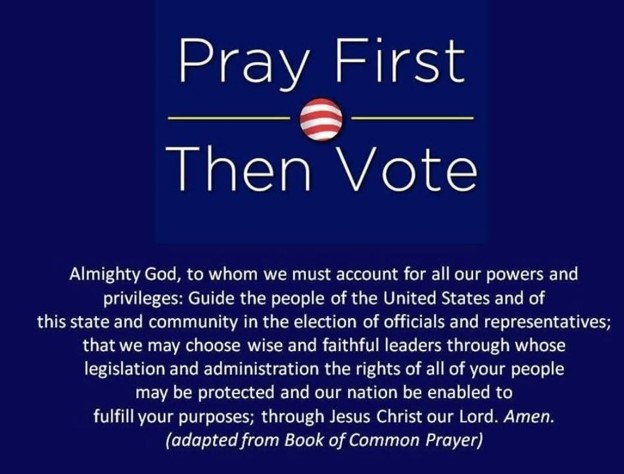
A prayer for us during this and all election seasons:
Almighty God, to whom we must account for all our powers and privileges: Guide the people of the United States, and of this state and community, in the election of officials and representatives, that we may choose wise and faithful leaders through whose legislation and administration the rights of all your people may be protected and our nation be enabled to fulfill your purposes; through Jesus Christ our Lord. Amen. (adapted from the Book of Common Prayer)