
Header Photo: Andy Weller walks the labyrinth at St. Patrick’s Church, Long Beach, with the aid of the Rev. Jane Bearden.
In October, I gathered with the clergy of the Episcopal Diocese of Mississippi at our annual Clergy Conference. This year’s topic? Pathways to Belonging: Places, Spaces and Accessibility. The goal of the conference was to help us learn how our worshiping communities could be more welcoming to all of God’s people. We heard from our LGBTQ siblings. We heard from persons who had mobility challenges, vision loss, and hearing loss. We heard from persons who struggle with mental illness. We heard specifically about ministry with mature persons as memories fade and ability to navigate spaces becomes more challenging.
We heard about the kinds of actions we could take to make our campuses more welcoming. We were reminded that a communicant who felt called to read lessons on Sunday mornings could do so from a pew if navigating steps to a lectern was no longer possible. We were reminded that communicants who wished to serve as ushers or chalice bearers could do so without navigating steps. We were reminded that deescalation training might be in order for all of our worshipping communities, so that we could respond with love when one suffering from mental illness might have become triggered.
And, armed with tools to help us faithfully evaluate our spaces, we will continue to study ways in which we can faithfully adapt our historical spaces that are currently inaccessible to persons experiencing mobility challenges.
We commended a book, My Body is Not a Prayer Request: Disability Justice in the Church (Amy Kenny), to remind us that churches must always be spaces in which worshippers—in the bodies God has given us—are able to fully utilize our gifts to the glory of God.
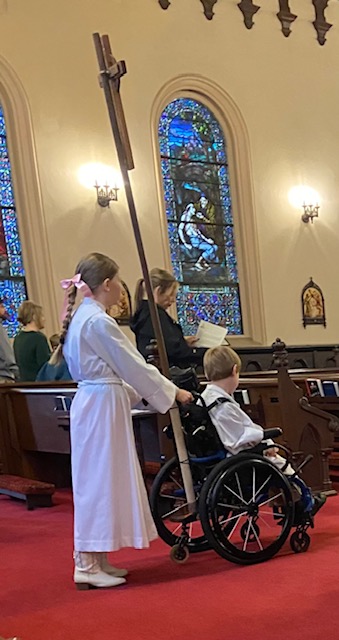
How do we begin to live into all of this?
The parish family at Church of the Holy Trinity, Vicksburg, shared some photos of a young man I recently confirmed there. Yes, he’s wheelchair-reliant. And, yes, you see him photographed here, serving as a crucifer (with a bit of help from an acolyte-friend!)!
Michael Maeze Williamson wanted to serve as a crucifer. His friends at Holy Trinity realized that by attaching PVC pipe to the back of his wheelchair to accommodate that cross, he would be able to serve. And he’s done so, proud of the fact that he could join with other young persons who serve there and take his part in worship. Senior Warden Bobbie Marascalco commented that she’d never seen Michael sitting up so tall in his wheelchair, and beaming so brightly.
I’ll admit that I couldn’t have been happier for him—and for the Holy Trinity parish family—to see these photos of him living out ministry there, and showing us all that God doesn’t place limitations on the ways that we can serve. The gift Michael has given us all is a glimpse of the Kingdom, where all of God’s people are indeed valued and loved.
We enter the season of Advent hearing the words of John the Baptist, reminding us that the Kingdom of heaven has come near. As we watch with expectant hearts for the One who is to come, we know our waiting is not a passive waiting, but an ever-watchful, ever-vigilant, ever-purposeful waiting. The “wait” for the ancient people called Israel for the coming of Messiah—over hundreds of years—had been full of warfare and exile, of grief and loss, of conflict and strife, of longing, of wondering for how long and for whom they waited, of needing to renew their faith, and living out that faith over so many generations. Mary’s nine-month “wait” was full—changes in her body as a child grew inside her; fear about how her own family and her fiancé’s family would receive her; visiting her kinswoman, Elizabeth and having this call upon her life affirmed; an arduous journey to Bethlehem. Who was this child for whom she was waiting? How would her own life change?
As we wait, filled with our own hope and expectation for the One who is to come, we might well recall the waiting of our forebears in the faith, and remind ourselves of the steps we take—embodied just as we are—in walking in true solidarity with our neighbors who need a dose of our hope that bring the Kingdom ever closer.
And we might recall these pictures of Michael—and know that the Kingdom draws just a bit closer with each step in love that we take.