St. Philip’s, Jackson, sits on seven acres of lovely land in north Jackson. Three of those acres provide the space for the church’s buildings and grounds. The other four are covered in woods and grassy areas. Parishioner Lester Hailey’s remembers neighorhood kids riding their bikes around through the woods on dirt paths over little hills and valleys and beside a small creek. Over the decades, though, the woods by St. Philip’s had become overgrown with vines and poison ivy. Hailey wondered for years what the church could do to better utilize the land.
The first step toward new life for the woods came when Hailey was approached by Jackson real estate agent and community activist Locke Ward, who has a passion for cleaning up sites around the city.
“He goes around and just cleans up anything,” says Hailey. “And he called me and wanted to know if he could clean the woods. He grew up riding bikes back there just like so many others, and thought it would be nice to do so. He got two guys with two pieces of big machinery and just cut it down to where it’s just trees and got all the undergrowth down.”
With the woods cleared, Hailey started thinking about next steps, and approached the Reverend Les Hegwood, rector of St. Philip’s, about creating a walking path as a resource for the church and the wider community.
“Lester and I and Dick David and some other members who have a heart for walking trails and this beautiful property that we have, we came together,” says Hegwood. “We agreed upon a plan.”
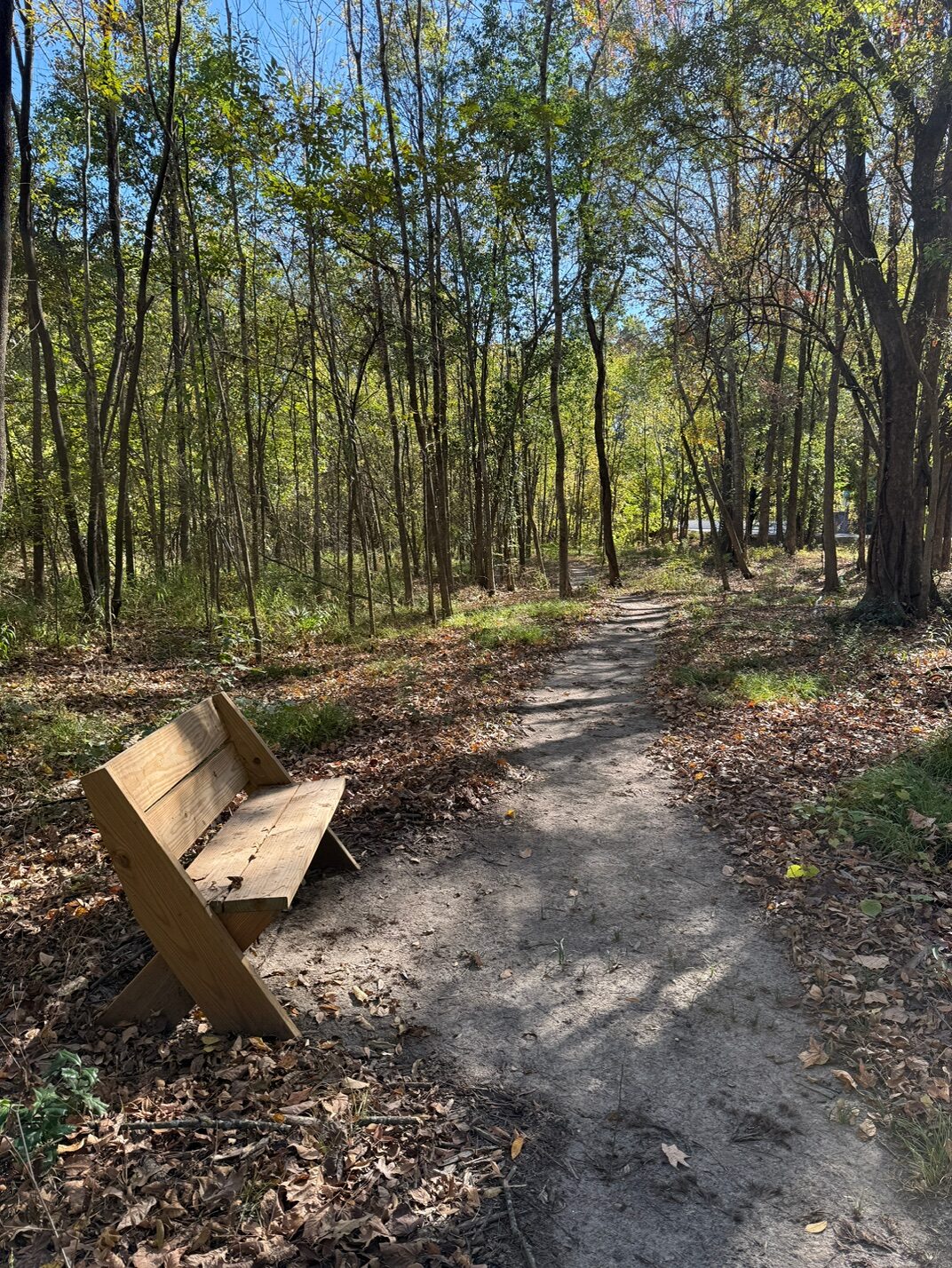 Eagle Scout Philip Browning, a parishioner nearby at St. James, Jackson, got engaged as part of his Eagle Scout Service Project and was instrumental in creating the path and building benches along the way.
Now, woods that had sat mostly untouched since the 1980s are a place for meditative walks, breaks from the office, or simply a chance to be outside in nature without having to leave the city.
Hegwood uses the trail frequently.
“Walking as a mystical practice resonates with something that I’ve been doing in my own spiritual practice for a really long time,” he says. “I’m a backpacker since I was 16, and when the going gets tough, I go and get in the woods and I walk.”
Hegwood and Hailey hope the community will make use of the path for similar purposes. In the near-term, there are plans for practical additions like signage to welcome the public, a native land acknowledgment, and the planting of native plants along the path.
Neither sees the project as complete, however. In the early dream phase are potential additions like a labyrinth, extensions to the trail itself, and other ways to further incorporate the woods with the existing courtyard and adjacent EYC room.
“This place, this campus, lends itself to contemplative work,” says Hegwood. “It’s somewhat of an oasis in the midst of what’s mostly suburban and urban. It just has that vibe all the way around.”
The trail has also created, in a sense, a new liturgical space. Shortly after it was cleared last year, the church set up a walking Stations of the Cross that parishioners utilized throughout Lent. Plans are in place to do so again this year.
But Hegwood emphasizes that St. Philip’s is dedicated to being a resource for all, not just parishioners or even just Episcopalians.
“All are welcome in that space,” he says. “St. Philip’s has to be in deep relationship and engagement with our immediate neighbors, and I think this is a physical way to do that. Anytime we can welcome people onto the campus, we want to do that and make it attractive and accessible to them.”