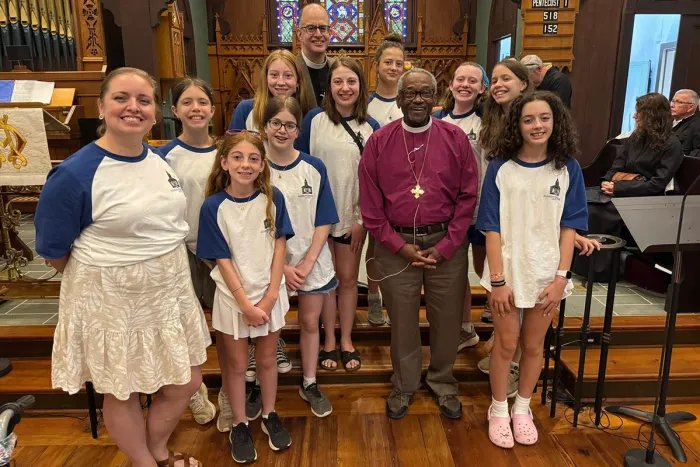
Travel. It typically ranks high on lists of retirement goals, offering an adventurous or relaxing break from the retiree’s former professional routine.
The Rt. Rev. Michael Curry is no typical retiree. Travel dominated his professional routine, and retirement clearly hasn’t slowed him down.
During his nine-year term as presiding bishop, Curry visited nearly all of The Episcopal Church’s more than 100 dioceses. Since stepping down in October 2024, rather than spend his first year of retirement resting back home in Raleigh, North Carolina, the former presiding bishop has scheduled a wide range of engagements almost as adventurous as before.
Episcopal News Service tracked Curry’s 2025 trips based on church announcements and social media posts and counted visits to nearly 20 Episcopal and Anglican dioceses in three countries, two university visits to accept honorary degrees, one civil rights pilgrimage in Alabama and numerous appearances at Episcopal churches within his own Diocese of North Carolina. He also participated in confirmations, conferences, panel discussions, funeral eulogies and more than a half dozen anniversary celebrations for churches, schools and dioceses.
And, of course, he preached. A lot.
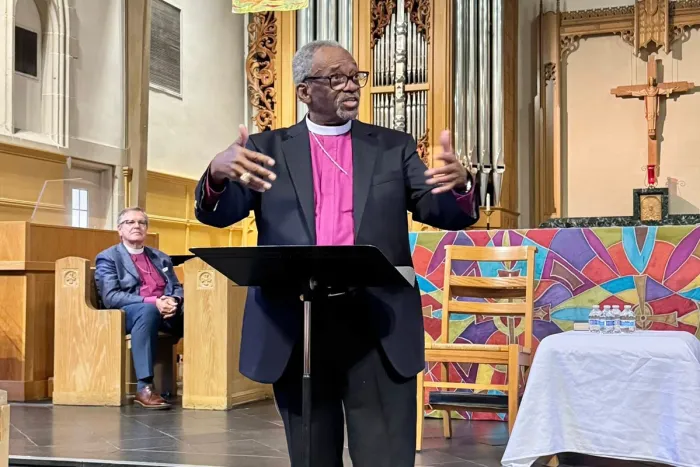
“I’m still kind of in discernment, to be honest, trying to think through long-term, how do I make a contribution?” Curry, who turned 72 in March, said in a recent Zoom interview with ENS from his home.
If Curry has spent the past year in discernment, it is safe to say he has done much of that discerning while on the move. Take the month of November, for example. The variety of Curry’s activities is evident in his several public appearances.
On Nov. 2, he officiated at an Evensong close to home at St. Michael’s Episcopal Church in Raleigh. On Nov. 13, he made headlines at the Texas Tribune Festival in Austin for saying he prays for President Donald Trump. On Nov. 18, he appeared alongside his former Canadian counterpart, the Most. Rev. Linda Nicholls, at Trinity College in Toronto, where both received honorary degrees. Then on Nov. 22 and 23, he visited Episcopal churches in Charleston, South Carolina, and preached there in celebration of a local partnership known as Three Churches United.
Curry told ENS his plan had been to average about two trips a month in the first year after handing the primatial staff to Presiding Bishop Sean Rowe. His intent was to support Rowe’s leadership, not to undercut it, and Rowe thanked Curry for keeping up such an active post-primacy schedule.
“I am grateful for Bishop Curry’s willingness to continue using his extraordinary gifts as a preacher and speaker to spread the gospel,” Rowe told ENS in a written statement for this story. “He is undoubtedly a tremendous blessing and encouragement to everyone he meets in his travels, and his evangelism is a light to the church in these uncertain times.”
Curry expects his travel schedule to slow down a bit in 2026, and he clarified that, even with all that activity this year, the routine still was far less strenuous than his time as a sitting presiding bishop, which comes with a full list of church responsibilities.
“It’s been a mix of things in a variety of places,” Curry told ENS. “I remember I talked with Sean and basically said I didn’t want to do anything that was ‘presiding bishop-like.’” Instead, he now sees himself as like the biblical Barnabas, serving as the “son of encouragement” for the church.
His described his trip to Trinity College, the seminary at the University of Toronto, as “an opportunity to talk about, in the context of the Anglican Communion, how do we live out what Jesus really taught us about each other and about how we care for each other and for this world?”
He also thanked the Anglican Church of Canada “for the way they and their leadership supported us in The Episcopal Church in the years that I was presiding bishop.”
A completely different scene awaited him in South Carolina, where three historically Black churches in Charleston have “come together” to do “some remarkable stuff,” Curry said. He couldn’t refuse the bishop’s and rectors’ invitation to join them and preach about racial reconciliation to a packed church.
“I didn’t expect that many people,” he said. “And when I looked out on the congregation, it was the mix of Black and white that was absolutely remarkable, to just stand there and see it.”
Other trips this year included a visit to Yale University in Connecticut to receive an honorary degree in May, the July funeral of the Very Rev. Sandye Wilson in Baltimore, Maryland, the Diocese of Alabama’s Jonathan Myrick Daniels pilgrimage in August, a September homecoming celebration at St. Paul’s Episcopal Church in Atlanta, Georgia, and the diocesan convention in Colorado in October.
Such frequent travel was common during Curry’s time as presiding bishop from 2015 to 2024, even after recovering from serious medical emergencies late in his tenure. Even so, these trips since stepping down have been different, in some ways more personal, and some of his favorite trips have been just a short drive across town or down the highway, to visit churches in the Diocese of North Carolina, which he led for 15 years as diocesan bishop.
In February, Curry spoke at Christ Church in Raleigh at an event honoring Black scholar Anna Julia Haywood Cooper. In April, he celebrated Holy Week in Greensboro. In June, he joined St. Matthew’s Episcopal Church in Hillsborough for its 200th anniversary celebration. And in October, he traveled to Charlotte to visit with Christ Episcopal Church and tour a new church building under construction. Other diocesan travels included Oxford, Burlington and Winston-Salem.
Curry isn’t officially an assisting bishop and doesn’t have a formal role with the diocese, but he has let North Carolina Bishop Samuel Rodman know he is available to help as needed. One example this year was a confirmation ceremony in the diocese. Rodman asked if Curry could assist with the ceremonial laying of hands on the heads of the confirmands.
“I was free that Sunday, and so I said, ‘I still have the hands. I can still do that,’” Curry said.
At other times, he has enjoyed going to Sunday services in the diocese with no bishop responsibilities — just a back-pew worshipper enjoying Holy Eucharist before the day’s football games.
“I’ve actually been able to follow the Buffalo Bills through wins and losses,” Curry said, something that hasn’t been possible since before he was a parish priest.
He also has had time to read and think more deeply. “I kind of jokingly say I haven’t been to any meetings — well, I really haven’t. I don’t have those kinds of responsibilities,” he said. “I’ve got a little bit more time for reflection.”
In particular, the parable in Luke 18 of the “persistent widow” has been weighing on his mind, “in the context of an unjust society.”
“It speaks to this moment,” he said. He may do some writing on the subject. “To be patiently impatient, that is the Advent message.”
Being a retired presiding bishop also means Curry can spend more time at home in Raleigh with his wife, Sharon Curry, and their two adult daughters. Often that time is spent watching TV soap operas, which Curry has found no less addictive in retirement.
And the Currys are preparing to welcome a new member to the family: a pet dog. They are working with a breeder in the region, though Curry wasn’t sure which breed they settled on. He only knows the family’s consensus was to go small.
“Little nerd dogs,” he called them. His family insisted.
“They said, ‘You don’t need a German Shepherd.’” With retirement has come acceptance of life’s compromises, at least regarding the dog. “I’ve given in,” he said.